
The DPU-Native Cluster: Offloading Kubernetes Primary Networking to Marvell OCTEON#
Executive Summary#
Kubernetes networking implemented through CNI plugin consumes a significant portion of host CPU cycles. Every packet traversing the cluster passes through the CNI data path for routing, policy enforcement, encryption, and observability. In traditional deployments, this data path is tightly coupled to the host CPU, meaning networking overhead directly competes with application workloads for compute resources.
By offloading CNIs like Cilium (with its eBPF-based data path) to a Marvell OCTEON DPU, organizations can:
Reclaim host CPU cycles for revenue-generating application workloads
Accelerate the data path in hardware for wire-speed packet processing, crypto, and policy enforcement
Improve workload density by running more Pods per node without networking bottlenecks
Enable future acceleration for hardware-assisted service mesh, encryption, and telemetry
While this white paper demonstrates offload with Cilium, the architecture is CNI plug-in Agnostic any CNI plug-in (Calico, Flannel, etc.) can be offloaded to the DPU with minimal adaptation.
The outcome is a repeatable blueprint where the kubelet still calls cniAdd, but the heavy lifting—veth creation, eBPF program execution, policy
enforcement—happens entirely on the DPU. Host CPUs are freed for applications, paving the way for richer in-fabric visibility, offloaded service meshes,
and zero-trust enforcement at wire speed.
Solution Overview#
What is Container Network Interface (CNI)?#
The CNI specification is intentionally minimal—four JSON verbs (ADD, DEL, CHECK, VERSION) that a binary must implement. When the kubelet
launches a Pod, it passes the Pod’s namespace, network-namespace FD, and a blob of configuration to the plug-in; the plug-in returns an IP, routes, and
optional metadata.
Because Kubernetes never looks behind that curtain, any data-plane technology—iptables, eBPF, OVS, SR-IOV, hardware offload—can be dropped in as long as it speaks the CNI API. This abstraction is what makes CNI offload possible without modifying Kubernetes core.
What is Cilium CNI?#
Cilium is the most widely adopted CNI in production Kubernetes environments, deployed at every major hyperscaler. Key capabilities include:
eBPF data path: High-performance packet processing without kernel module modifications
L3-L7 policy enforcement: Network policies, HTTP-aware rules, and service mesh integration
Deep observability: Hubble provides real-time flow visibility and metrics
Identity-based security: Workload identity for zero-trust networking
Cilium’s production burn-in and comprehensive feature set make it the default choice for CNI offload demonstration.
Why Offload the Primary CNI to a DPU?#
A DPU (Data Processing Unit) adds an isolated NIC-attached SoC that can run Linux, offload switching, crypto, and telemetry—without stealing host resources. Offloading the primary CNI to the DPU provides:
Zero host CPU overhead: All packet processing, policy enforcement, and observability run on the DPU
Improved workload density: More host cores available for application Pods
Consistent security posture: Policy enforcement happens at wire speed with hardware acceleration
Simplified operations: No secondary network to manage; existing Kubernetes workflows unchanged
Architecture Diagram & Design#
The architecture deploys CNI components across host and DPU, connected via PCIe Endpoint and SR-IOV for high-performance packet I/O.
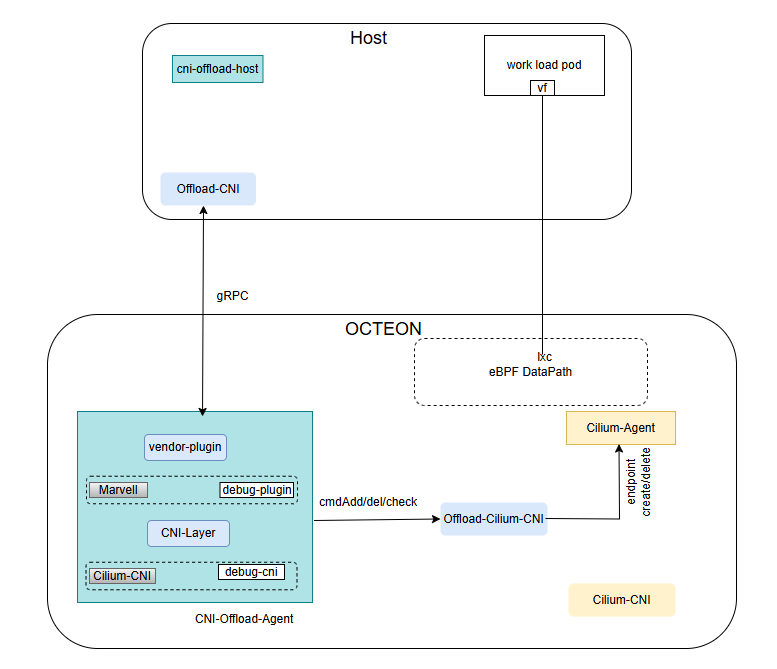
Kubernetes CNI offload: Cilium data path on OCTEON DPU with SR-IOV packet I/O and gRPC control plane.#
Highlights: What OCTEON Adds#
When Cilium runs on OCTEON platforms, Marvell acceleration enhances CNI performance:
Dedicated packet processing: DPU cores handle all eBPF execution, freeing host CPUs
Hardware crypto acceleration (CPT): Wire-speed encryption for encrypted overlay networks and service mesh mTLS
Predictable latency: Isolated DPU processing eliminates contention with application workloads
Enhanced observability: Telemetry collection and export without host CPU impact
Higher workload density: More host cores available for revenue-generating applications
How To Use#
The complete source code, deployment instructions, and configuration guides for this solution are available in the open-source repository:
MarvellEmbeddedProcessors/k8s-cni-offload
The repository includes:
Host-side components:
cni-offload-hostDaemonSet andoffload-cnibinaryDPU-side components:
cni-offload-agentand Cilium integrationDeployment manifests: Kubernetes YAML files for both host and DPU clusters
Configuration examples: Sample CNI configurations and gRPC settings
Build instructions: Steps to compile and package all components
At a high level, the deployment workflow is:
Prepare a Kubernetes cluster with Marvell DPU hardware attached via PCIe Endpoint.
Install the host-side kernel drivers (
octeon_ep.ko,octeon-ep_vf.ko).Deploy
cni-offload-hostDaemonSet to install the CNI shim on worker nodes.On the DPU, deploy Cilium and the
cni-offload-agentDaemonSet.Configure SR-IOV for high-performance packet I/O between host Pods and DPU.
Verify connectivity by deploying test Pods and observing network traffic on the DPU.
Refer to the repository README and documentation for detailed step-by-step instructions.
Key Takeaways#
Zero-patch offload: The entire Cilium data path runs on the DPU without modifications to Kubernetes, CRI, or the node OS.
Minimal host footprint: Only a thin gRPC shim runs on the host; all packet processing and policy enforcement happen on the DPU.
Upstream-friendly: The offload architecture requires minimal Cilium changes, making upstream rebases trivial.
Extensible pattern: The same architecture can be adapted to offload other CNIs (Calico, etc.) to the DPU.
Production-ready components: Leverages battle-tested Cilium, SR-IOV, and PCIe Endpoint technologies.
This PoC is a first step toward making the DPU the default home for Kubernetes primary networking, freeing host CPUs for applications and paving the way for richer in-fabric visibility, offloaded service meshes, and zero-trust enforcement at wire speed with OCTEON’s crypto acceleration capabilities.